
Hands-on EMC troubleshooting & DebugGing Workshop
Step-by-Step EMC Troubleshooting course with LISN, Spectrum Analyzer, Current Clamp, and Sniffer Probes


Four-Day EMC Debug Workshop
Written by Dr Ali Shirsavar in his approachable, easy-to-follow style, this Four-Day EMC troubleshooting and Debugging Workshop is fundamentally different from traditional EMC training. While most EMC courses focus heavily on theory and limited front-of-class demonstrations, in true Biricha style this workshop is built around individual hands-on lab work and real hardware debugging.
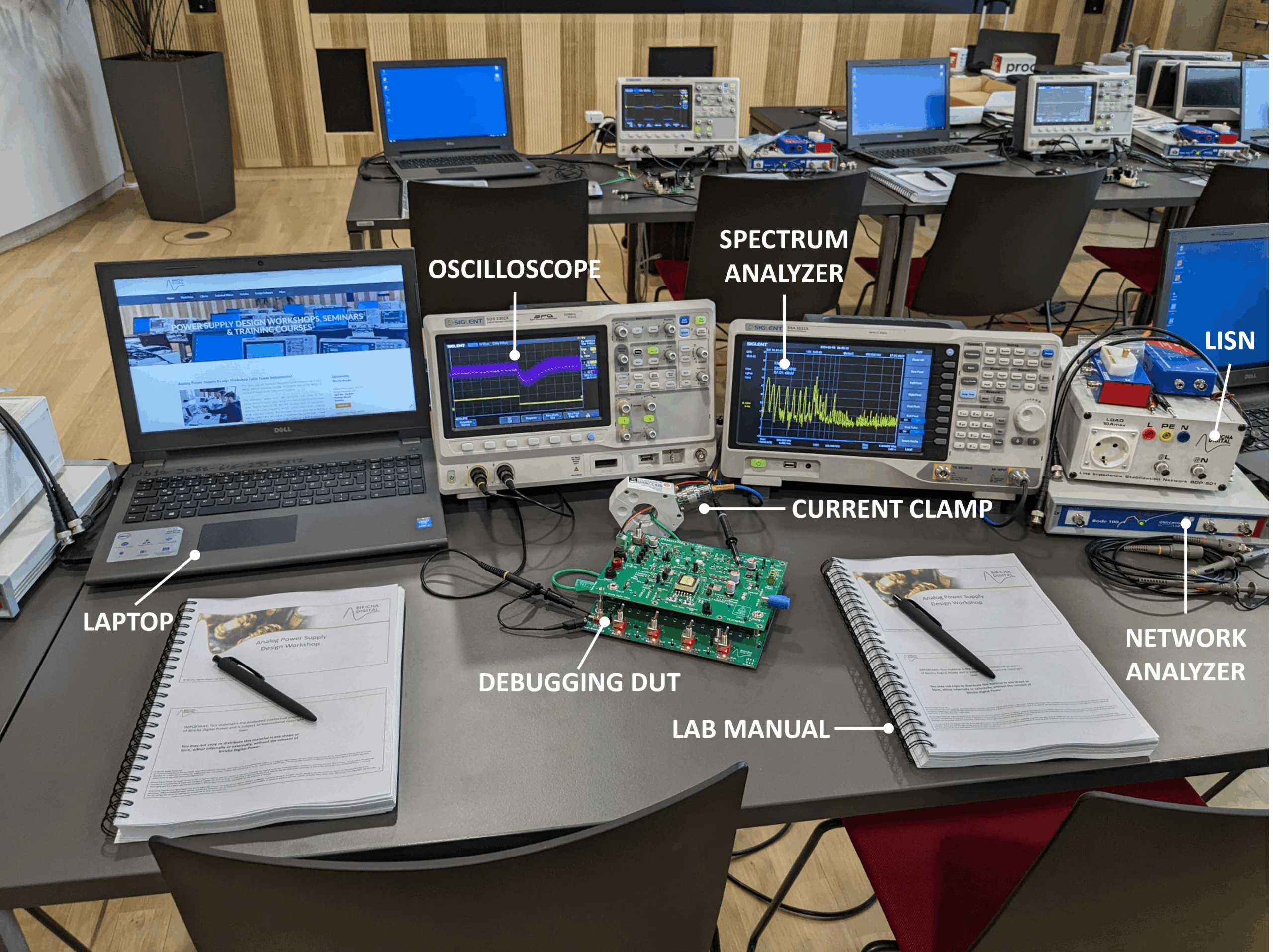
After each theoretical concept is taught, each participant works at their own fully equipped lab station and is provided with specially designed training boards that contain known EMC problems. The students are required to measure, identify, and fix real conducted emissions, radiated emissions, and immunity issues themselves, using professional test equipment including LISNs, spectrum analyzers, network analyzers, current clamps, near field probes, and ESD tools.
The course focuses on hands-on debugging methods that engineers can directly use in real development projects, allowing participants to build repeatable problem-solving skills that can be immediately transferred into their own pre compliance and product development environments..
These workshops are designed for electronic engineers who:
- Need to quickly identify and fix EMC problems during product development
- Want to become confident using EMC measurement equipment for pre compliance debugging
- Are responsible for improving conducted and radiated emissions performance
- Need practical experience with immunity testing and susceptibility troubleshooting
- Want to reduce design iteration cycles and accelerate time to market
- Need structured, hands on EMC training rather than theory only seminars
- Need to add a minimum of 28 hours of continuous professional development hours to their portfolio
What engineers are saying about Biricha workshops:
“This is the kind of training every design engineer wishes they had earlier in their career.”
Workshop Overview
This Four-Day EMC Debugging Workshop is designed to take engineers step by step from fundamental EMC principles through to practical emissions and immunity debugging. Over four days, participants learn how to identify noise sources, apply effective mitigation techniques, and systematically work toward passing EMC compliance testing.
Starting from EMC fundamentals and measurement techniques, it progressively covers all major EMC debugging domains:
- Conducted emissions debugging (150 kHz to 30 MHz)
- Radiated emissions debugging (30 MHz and beyond)
- Immunity testing and susceptibility fault finding and troubleshooting
- Component selection and mitigation techniques for compliance
Numerous laboratory exercises and debugging examples are based on specially designed training boards that intentionally include common conducted emissions, radiated emissions, and immunity related EMC problems. This allows participants to practice realistic fault finding and mitigation techniques that directly reflect real-world compliance challenges.
Participants work either individually or in pairs at one of 10 fully equipped EMC debugging workstations. Each station includes a pre-compliance LISN, spectrum analyzer, current clamp, near-field probes, ESD equipment, and supporting laboratory instrumentation required for emissions and immunity debugging. This setup ensures that every attendee actively performs measurements, debugging, and mitigation verification throughout the course.
To maintain a high level of hands-on participation and instructor interaction, the total number of attendees is strictly limited to 20 per engineers session. This guarantees sufficient lab equipment, direct instructor support, and meaningful individual practice time.
Upon successful completion of the workshop, participants receive a certificate for their professional development records. Attendance and active participation throughout the majority of the workshop sessions are required to qualify for certification.
Agenda (total 28 hours of CPD)*
Day 1: EMC Fundamentals and Debugging Foundations
- Fundamentals of EMC compliance and testing concepts
- Understanding conducted and radiated emissions measurement principles
- Noise coupling mechanisms including capacitive, inductive, and electromagnetic field coupling
- Linking frequency-domain noise signatures to real circuit boards and layout coupling paths
- Step-by-step EMC debugging workflow
- Hands-on labs include:
- Hands-on operation of LISNs, spectrum analyzers, current clamps, near-field probes, and ESD tools
- EMC instrument setup and pre-compliance measurement techniques
- Noise coupling demonstrations and reflection experiments
- Frequency-domain noise pattern recognition exercises on real hardware
Day 2: Conducted Emissions Debugging and Mitigation (150 kHz to 30 MHz)
- Fundamentals of conducted emissions measurements and regulatory limits
- Identifying dv/dt-related capacitive noise mechanisms
- Identifying di/dt-related magnetic coupling mechanisms
- Ringing and resonance identification in switching power supplies
- EMC input filter fundamentals and compliance-driven filter design concepts
- Hands-on labs include:
- Real conducted emissions debugging in our lab including:
- LISN-based noise observation and root cause identification
- Debugging techniques and EMC fault finding using a spectrum analyzer and a LISN
- Snubber tuning and switching noise mitigation demonstrations
- EMC input filter performance verification
Day 3: Radiated Emissions Debugging and Mitigation (30 MHz and Beyond)
- Understanding radiated emissions testing and how they relate to bench measurements
- How to use current clamps to locate radiation failure sources on cables and PCBs
- PCB-level noise source localization using near-field probes
- High-speed digital and clock-related radiation mechanisms
- Hands-on labs include:
- Current clamp-based cable and PCB radiation analysis
- Near-field probe PCB scanning and hot-spot identification
- High-speed clock and digital noise fault finding exercises
- Debugging circuits with multiple clocks and switching frequencies
Day 4: EMC Immunity Testing and Susceptibility Debugging
- Radiated and conducted immunity test fundamentals and performance criteria
- Understanding EFT, surge, and ESD disturbance mechanisms and real-world interference sources
- Debugging using ESD stress testing to locate susceptibility points and weak design areas
- MOV/TVS and Clamp-on ferrite core selection techniques for immunity improvement
- Hands-on labs include:
- Locating and fixing susceptibility issues using controlled ESD stress testing
- Noise injection techniques using current clamps for susceptibility testing
- Using EMC input filters to improve conducted immunity susceptibility performance
- Comparing poor versus optimized PCB layouts to evaluate layout impact on immunity behavior
Workshop Logistics
Europe
Monday 30th November – Thursday 3rd December 2026
Freiham, Munich, Germany
Workshop Language is English
2950 EUR for 4 days
North America
Tuesday 9th June – Friday 12th June 2026
Montreal, Canada
Workshop Language is English
2950 USD for 4 days
For more future dates, please contact us.
The class runs from 9:00am – 5:00pm depending on the lab on Day 1 – 3.
The class runs from 9:00am – 2:00pm on Day 4 to allow for easy travel.
The price includes:
- One seat at the workshop
- All necessary calculation spreadsheets used in the class
- Comprehensive lecture notes and detailed step-by-step lab manual
- Lunch and refreshments throughout each day
- CPD certificate – upon competition of at least 85% of the course
Workshop Locations
Montreal, Canada: We are located at the very heart of Montreal, at the Goethe Institut near Place des Arts, within a few minutes walking distance of hotels, shops, restaurants and coffee shops. You will be within a few minutes walking distance of Saint Laurent Metro Station. Montreal has excellent public transport links including Uber and Taxis are readily available and therefore you do not need a rental car for this location.
Montreal-Pierre Elliott Trudeau International Airport (YUL) connects the city to the world, with direct flights from major cities across North America and Europe. From the airport, downtown Montreal is just a 20-minute ride via taxi, Uber, or public transportation (bus 747 to station Berri-UQAM and then take the green line Metro and head in the direction of Angrignon to Saint Laurent Metro station).
Known for its warm hospitality, vibrant atmosphere, and rich history, Montreal provides the perfect balance of professional development and cultural exploration. There are many affordable hotels nearby with several being located less than a 5 minute walking distance. Click here for a map of nearby hotels.
Freiham (Munich), Germany: The workshop venue is located at the state-of-the-art facilities of Würth Elektronik in a peaceful setting, perfect for focused learning. Attendees can extend their stay to enjoy the rich history and culture of Bavaria, one of Germany’s most picturesque regions.
Freiham is easily accessible by train, car, or air. The nearest airport is Munich International Airport (MUC), just a short taxi, Uber ride or train ride away. There is a direct route from Munich Airport: train S8 from the airport in the direction of Herrsching and get off at Bahnhof Freiham. There are hotels, restaurants, and shops within walking distance of our venue. You do not need a rental car for this location. There is a hotel opposite the venue called Coffee Fellows, click here for their website.
Other locations: Our workshops are only offered in the listed locations. Each session is highly lab-intensive and requires a large amount of specialized equipment. Because of this, we are unable to host workshops in other locations, as transporting the equipment across borders and through customs presents significant logistical challenges.
Prerequisites
The audience should have a degree in electrical/electronic engineering, computer science or equivalent.
These workshops are highly technical, intended for professional engineers and are not suitable for the general public without relevant qualifications.
Cancellation Policy
Workshops may be cancelled if the minimum number of attendees (5) is not met 10 days before the scheduled date. In such cases, a full refund will be issued. The maximum number of participants is capped at 20. In the event of last-minute cancellations by Biricha due to unforeseen circumstances, the liability of Biricha and its partners is limited to a refund of course fees. No refunds will be issued for confirmed participants who do not attend the scheduled session. However, if you are unable to attend, you may transfer your registration to a colleague or reschedule for a future workshop.
Testimonials
This workshop is new, be the first to write a testimonials. Here is what people say about our other workshops 🙂
- “This workshop is from Engineer to Engineer; it covers a lot of background knowledge together with practical hands-on labs”
- “Absolutely positive: it was free of marketing slides 🙂 ““The best power supply related training/seminar I’ve ever participated by far !!!”
- “Ali is a gifted teacher and succeeds in bringing complex technical challenges in a structured, well-explained way. I would recommend all engineers in the field to take the workshop !”
- “The workshop touches very important topics in analog power supply design world. I would recommend the workshop to any power supply design engineer or researcher.”
- “Great Hands-on workshop with a good mix of theory and lab sessions. Very valuable for my daily work”
- “I would recommend this workshop for every engineers who are involved in SMPS design. It’s worth every penny.”
- “Very good seminar! Interactive experience with valuable Hands-on”
- “Excellent workshop, very knowledgeable facilitator, good atmosphere, highly recommended”
- “Course content and pace were excellent. Room, service and location were very good. Cannot think of any improvements. Thank you!”
- “I enjoyed the course and would recommend it to others. The pace and content were good and it was very well presented. The facilities and environment were also good.”
- “The presenter did a really good job. The facility was very good, especially the coffee was great!”
- “Practical, straightforward as all trainings should be.”
- “An excellent introduction to power supply design, covering both the theoretical principles and practical applications.”
- ”A really practical course on how to design filters”
- “Helps you “Design” EMI filters instead of trial and error.”
- “Though this topic is complicated the workshop is easy going; I am really looking forward to the next one ;)”
Upcoming Workshops
Since 2008 Biricha has run highly popular hands-on workshops and industrial seminars. Some of the companies who have attended our workshops include:
AAC Microtec
ABB Medium Voltage Products
ABB Robotics
ABB Stotz-Kontakt GmbH
Ablepower Corp
Accutronics Ltd
Acme Aerospace
Adaptive Materials, Inc.
Advanced Space Power Equipment
Advantest Europe GmbH
AEG Power Solutions
Agemont SpA
Altergy Systems
Ametek
Apple Inc.
APtronic AG
ARROW DE
Arrow Denmark
ARROW SWEDEN
Artesyn Austria G.M.B.H & Co Kg
Artesyn Embedded Technologies
ARTI Industrial Electronics
Aselsan Elektronik San. Ve Tic. Inc.
Astrium GmbH
Aurora Networks
Automotive Ingenieurbüro
Avent Silica
AVL List GmbH
Baker Hughes Inteq
Beckman Coulter, Inc.
Belscanti
Beru Electronics GmbH
BMW – Bayerische Motoren Werke AG
BOSCH communications Systems EVI Audio GmbH
Bosch ST
Bose Corp.
BTicino S.p.A.
CAMCO Produktions und Vertriebs
Cassidian
Cassidian Electronics
CB Svendsen A/S
Chamberlain
Cisco Systems, Inc.
CM Comandos Lineares
Cobham Satcom
Cobree
Continental Automotive Austria GmbH
Continental Corporation
Contronics Engineering BV
Corrosion Service
Crane Electronics, Inc.
Cranfield University
Cybercom Sweden AB
Delphi
Delta Energy Systems
Delta Energy Systems (Switzerland) AG
Delta GmbH
Develco A/S
Dialog Semiconductor
Diehl Aerospace
Dinema S.p.A.
Dipolar AB
Dp Applications Engineering
DRS Pivotal Power
DRS Technologies
Dynexsemi
E Plug AS
EADS Germany GmbH
Eaton Corporation
Eberspächer Controls GmbH & Co. KG
EBV Elektronik
EcoPower
Effekta Regeltechnik GmbH
Efore
Elreg as
Elsis A.S.
Eltek
Eltek Valere Inc.
Emerson Process Management
Enersys
Ericsson AB
Ericsson Hungary Ltd.
Et System Electronic Gmbh
eta plus electronic gmbh
Etteplan Design Center
F5 Networks
Fairchild Semiconductor
Fieger Consulting&Softwaredesign
Filtran Limited
Flex Power
FMC Technologies Schilling Robotics
Fohhn Audio Ag
Fr.Sauter Ag
Fronius International GmbH
GE Aviation
GE Lighting
Gebrüder Frei GmbH & Co.
General Atomics Aeronautical
General Atomics Aeronautical Systems, Inc.
General Physics France
Georgia Tech
Golden Motor USA
Goodrich Aircraft Wheels and Brakes
Google Inc
Gordon Design Ltd
Gotec
Grundfos
Hamworthy Oil & Gas AS
Heim Electronic GmbH
Heinzinger electronic GmbH
Hewlett-Packard Co
HeyTech Systementwicklung
Hirschmann Automation and Control
Huawei
Huawei Technologies Sweden AB:
Icepower A/S
idem
Imagination technologies
Infineon Technologies AG
Ingenieurbüro Edel
Ingenieurbüro Sierak
Institut ELSYS
Intel Corporation
IPT Design
IPT Technology GmbH
ITT
J.W. Speaker Corperation
Jablotron Alarms
JPL (NASA)
JTOE GmbH Co. KG
JW Speaker
Kacst
kk-electronic a/s
Knorr Bremse SFS GmbH
KOSTAL Industrie Elektrik
L 3 communications
Lacon embedded
Lear Corporation
Lear Corporation GmbH
Leopold Kostal GmbH & Co.KG
Life Technologies
Liftoff
Lincoln Electric
Linde Material Handling GmbH
Lineage Power
Linera
Linestream Technologies
Lockheed Martin
Magma Mekatronik Makine San. ve Tic. A.S.
Martek Power
Martekpower
Megger
Meta System S.p.A
MGV Stromversorgungen GmbH
Microchip
Mikrokrets AS
Miller Electric
MITSUBISHI ELECTRIC
ML Electronics
Moog
MORI L. RADDRIZZATORI SRL
Moxtek Inc
Murata Power Solutions
NMB-Minebea GmbH
North China University of Technology
Norwegian Univ of Sci & Tech
NXP
Odel S.p.A.
OMICRON Lab
ON Semiconductor
Ortoceratit Ab
OSB AG
Osram GmbH
OSRAM SPA
TDK-Lambda Americas
Technologie Netzwerk Allgäu
Tehnical University of Denmark
Texas Instruments
THALES Avionics
Thales Communications, Inc.
Thita Elektronik
Thrane & Thrane A/S
Thurlby Thandar Instruments Ltd
TMD
Tomra Systems ASA
Triton Electronics Ltd
Tttech Computertechnik Ag
Tucker GmbH
Unisa
Unitech Energy AS
Università degli Studi di Salerno
Università Politecnica Delle Marche
University Of Applied Science Darmstadt
University of Nottingham
University of Salerno
University of Zilina
UTC Aerospace Systems – Wheels & Brakes
UTRC
VACON Oyj
Vektrex
Versatile Power
W-IE-NE-R Plein & Baus GmbH
WesternGeco AS
Wiener Plein & Baus
Wijdeven PS&IT
Würth Elektronik Eisos Gmbh & Co.Kg
Xcel Power
XSembedded GmbH
Zefatek Co., LTD
* Workshop syllabus and schedule are subject to change.